









A couple of years ago, implementing a chatbot was revolutionary.
Everyone was hyped about automated responses, immediate customer service, and 24/7 round-the-clock support.
Of course, back then, the concept made plenty of sense.
Chatbots were great at reducing the workload on customer support staff and allowing visitors to find answers without the need for additional waiting time.
However, the situation has changed quite drastically since.
Nowadays, online businesses don’t want any ordinary chatbot responding with scripted answers.
No one cares about a simple message like:
“Your purchase was delivered successfully.”
What people really need are intelligent systems capable of accomplishing certain actions.
Systems that can do not just tell, but complete tasks like:
“I located the delayed order, opened a ticket, informed you about the issue, and sent you a compensation coupon.”
That’s the distinction between traditional automation and the next step in eCommerce — Agentic AI.
Why This Concept Will Define the Future of eCommerce
So, what exactly does Agentic AI mean?
The idea is simple enough:
Traditional automation follows a set of rules.
AI operates toward objectives.
Surely, those two concepts look quite similar. However, their actual difference is tremendous.
Typically, automated processes depend on predefined conditions:
- If the customer submitted a form → Send email
- If the user placed an order → Change inventory status
- If the payment was unsuccessful → Notify user
While such systems do work properly, they can hardly cope with the unpredictability inherent to the modern market environment.
The issue is that eCommerce businesses rarely face predictable scenarios.
A normal day for an online store may involve:
- Unexpected customer questions,
- Delayed shipments,
- Fluctuating inventory,
- Failed marketing campaigns,
- And support teams overwhelmed with repetitive requests.
As a result, businesses are actively looking for systems that can understand situations and take intelligent actions automatically.
That’s where AI agents become incredibly valuable.
Instead of simply executing scripts, AI agents can:
- Analyze Context,
- Make decisions,
- Communicate with multiple systems,
- And execute workflows autonomously.
In many ways, they function less like software and more like digital team members.
And for businesses managing thousands of operations every day, that becomes a major operational advantage.

Why This Matters More Than Ever for eCommerce Businesses
Running an eCommerce business today is far more demanding than it was even five years ago.
Customers now expect:
- Faster deliveries,
- Personalized shopping experiences,
- Instant support,
- Seamless communication,
- And highly accurate product recommendations.
At the same time, businesses are struggling with:
- increasing competition,
- rising acquisition costs,
- operational overload,
- and growing customer expectations.
Under these circumstances, scaling manually becomes extremely difficult.
This is one of the biggest reasons AI adoption in eCommerce has accelerated rapidly over the last year.
Not because companies simply want “AI features.”
But because businesses genuinely need smarter operational systems.
While working with modern web and eCommerce platforms, we’ve noticed a growing shift in how businesses think about automation.
They are actively searching for ways to:
- reduce repetitive tasks,
- improve customer experiences,
- streamline operations,
- and scale without constantly increasing team size.
AI agents fit naturally into these challenges.
Moving Beyond Chatbots
One of the biggest misconceptions about AI in eCommerce is the belief that AI simply means chatbots.
In reality, chatbots represent only a very small portion of what modern AI systems can do.

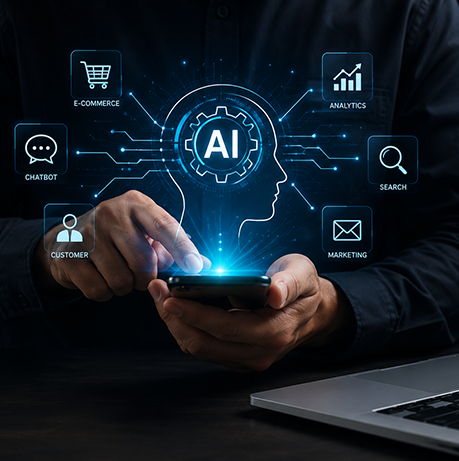
Today’s AI systems are evolving into intelligent operational layers capable of interacting with:
- CRM systems,
- inventory tools,
- support platforms,
- analytics dashboards,
- payment gateways,
- marketing tools,
- and entire eCommerce infrastructures simultaneously.
For example, imagine a customer asking:
“Can I exchange this product for another size?”
A traditional chatbot might respond with:
“Please check our return policy.”
But an AI agent can:
- identify the customer,
- locate the order,
- check inventory availability,
- initiate the exchange process,
- prepare shipping instructions,
- and update support systems automatically.
That goes far beyond customer support.
That’s intelligent workflow execution.
And this is exactly where modern eCommerce operations are heading.

Why Personalization Has Become Essential
Another major reason AI adoption is growing rapidly is changing customer behavior.
Generic shopping experiences no longer work.
Customers now expect online stores to understand:
- their preferences,
- purchase history,
- browsing behavior,
- and even future buying intent.
Large marketplaces have already trained customers to expect highly personalized digital experiences.
As a result, small and mid-sized businesses are now under pressure to deliver similar experiences as well.
This is where AI systems create enormous value.
Modern AI-powered platforms can:
- analyze customer behavior in real time,
- dynamically adjust recommendations,
- personalize offers,
- generate targeted campaigns,
- and customize entire shopping experiences.
The best part?
This level of personalization is no longer limited to enterprise companies.
With technologies like Next.js, Node.js, Laravel, and modern AI APIs, intelligent systems are becoming accessible for growing businesses too.
Why AI Is Becoming Easier to Implement
One of the biggest myths surrounding AI implementation is the idea that businesses need to rebuild everything from scratch.
Fortunately, that’s no longer true.
Modern AI systems integrate surprisingly well into existing infrastructures.
Whether businesses operate on:
- WordPress,
- Laravel,
- Next.js,
- Node.js,
- headless commerce architectures,
- or custom applications,
AI functionality can often be added incrementally without major disruptions.
That’s an important shift because companies no longer need massive digital transformations before seeing value from AI.
Even relatively small implementations can create meaningful operational improvements:
- customer support automation,
- AI-driven SEO content generation,
- abandoned cart recovery,
- workflow optimization,
- and customer segmentation.
And once businesses begin seeing measurable improvements, adoption usually expands naturally.
What the Future of eCommerce Looks Like
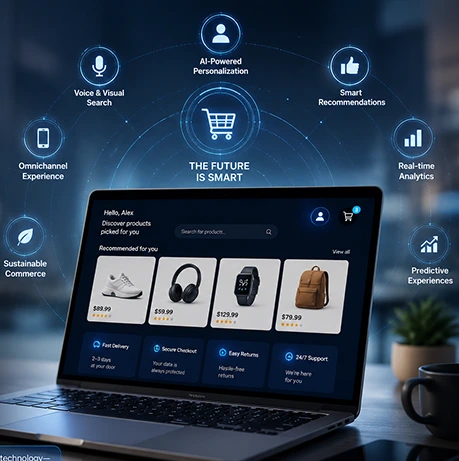
We are entering a phase where eCommerce platforms will become increasingly intelligent and autonomous.
Not fully automated.
Not human-free.
But significantly smarter than today’s systems.
In the near future, AI-powered systems will continuously monitor:
- customer behavior,
- operational bottlenecks,
- inventory trends,
- support activity,
- and marketing performance.
Instead of teams manually reacting to every issue, intelligent systems will proactively identify problems and execute solutions automatically.
This changes how businesses scale.
Companies that successfully combine human creativity with AI-powered operational efficiency will move significantly faster than competitors still relying entirely on manual processes.
And honestly, this transformation has already started.
Looking to Implement AI in Your Business Processes?
We specialize in building scalable digital platforms using technologies like WordPress, Laravel, Next.js, Node.js, and modern AI-driven automation systems that help businesses streamline operations and create smarter digital experiences.
From workflow automation and intelligent support systems to AI-powered business processes, we focus on building practical solutions that generate measurable business value.
And for businesses looking to scale their eCommerce operations, we also build high-performance solutions on Shopify tailored for modern online growth.
If you’re planning to adopt AI in your eCommerce operations, now is the perfect time to start building.
Let’s Talk
Explore how Agentic AI is transforming eCommerce with intelligent automation, personalized experiences, and proactive customer engagement.